TAXP010 and Corporate Tax Designated Zones: has the FTA narrowed the concept?
On 2 October 2026, the Federal Tax Authority published Public Clarification TAXP010, “Free Zones and Designated Zones for Tax Purposes”. The clarification is useful for a number of reasons, but one point is particularly interesting for the Corporate Tax treatment of distribution activities: what exactly is the geographical area that qualifies as a “Designated Zone” for Corporate Tax purposes?
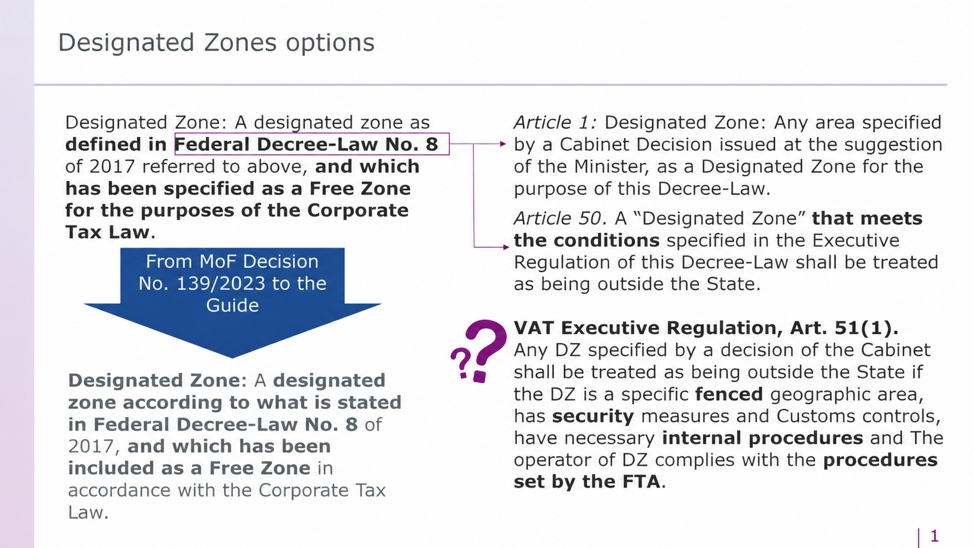
We raised this question in an earlier LinkedIn post following a webinar, using the slide reproduced below. The question was whether a Free Zone included in the Cabinet list of VAT Designated Zones could still qualify as a Designated Zone for Corporate Tax purposes where the relevant part of the Free Zone did not satisfy the conditions for being treated as outside the UAE for VAT purposes.
The statutory position: designation and ‘outside the State’ treatment are two different questions
The starting point is the VAT Law. Article 1 defines a “Designated Zone” by reference to “any area specified by a Cabinet Decision issued at the suggestion of the Minister, as a Designated Zone for the purpose of this Decree-Law”. Article 50 then provides that a “a “Designated Zone” that meets the conditions specified in the Executive Regulation of this Decree-Law shall be treated as being outside the State”. The legislation therefore establishes two separate steps:
an area acquires Designated Zone status by being specified as such by Cabinet Decision;
Designated Zone is treated as outside the State only if the additional conditions prescribed by the Executive Regulation are satisfied.
Article 51(1) of the VAT Executive Regulation contains those additional conditions. In particular, the Designated Zone must be a specific fenced geographic area, have security measures and Customs controls, maintain internal procedures regarding the keeping, storage and processing of goods, and its operator must comply with procedures set by the FTA.
The FTA’s VAT Guide on Designated Zones No. VATGZ1 historically supported the distinction. Under Section 2.2:
“a Designated Zone is an area specified by a Cabinet Decision as being a “Designated Zone”.Free Zones listed by the Cabinet Decision as being a Designated Zone can be found under the Legislation tab on the FTA website (www.tax.gov.ae)”.
“Although an area might be identified as a Designated Zone, it is not automatically treated as being outside the UAE for VAT purposes. There are several main criteria must be met in order for a Designated Zone to be treated as outside the UAE for VAT purposes”. They are listed in Article 51 of the Executive Regulation.
“This means that where a Designated Zone has areas that meet the above requirements, and areas that do not meet the requirements, it will be treated as being outside the UAE only to the extent that the requirements are met. In addition, should a Designated Zone change the manner of its operation or no longer meet any of the conditions imposed on it which led to it being specified as a Designated Zone by way of the Cabinet Decision, it shall be treated as though it is located within the territory of the UAE”.
Against that background, the literal statutory conclusion was that failure of a particular part of a Cabinet-listed Designated Zone to satisfy Article 51(1) affects whether that part is treated as outside the State for VAT purposes, but does not remove its status as part of the Designated Zone specified by Cabinet Decision. Since the Corporate Tax definition refers to a Designated Zone according to the VAT Law, rather than to a Designated Zone treated as outside the State under Article 50, Article 51(1) conditions should not, on the wording of the legislation, determine the geographical scope of a Designated Zone for Corporate Tax purposes.
What TAXP010 changes
Certain passages of TAXP010 nevertheless introduce a narrower administrative concept which is difficult to reconcile with that statutory structure. In its VAT summary, the FTA states that “A VAT Designated Zone is a Free Zone that is listed in Cabinet Decision No. 59 of 2017 and its amendments that meets the conditions specified in Article 51(1) of the VAT Executive Regulation”. In the detailed analysis, it goes further and describes a ‘VAT Designated Zone’ as a “any specific fenced geographic area, specified in the List of Designated Zones, provided it meets the conditions prescribed under Article 51(1) of the VAT Executive Regulation”.
The clarification then addresses the issue at company level: “In order to determine if a company is located within a VAT Designated Zone, a company must review the List of VAT Designated Zones published by the FTA on its website, and confirm with the relevant free zone authority that the conditions provided in Article 51(1) of the VAT Executive Regulation are also met by the specific area of the VAT designated zone where the company is based”. This wording is important because it appears to eliminate the distinction between a Designated Zone that is treated as being inside the State and a Designated Zone that is treated as being outside the State. Instead, the FTA appears to recognize only one category of VAT Designated Zone: a zone that is treated as being outside the State and therefore satisfies the conditions set out in Article 51(1) of the VAT Executive Regulation the VAT Executive Regulation.
For Corporate Tax, TAXP010 repeats the definition of a Designated Zone as a designated zone according to the VAT Law which has also been included as a Free Zone under the Corporate Tax Law. It then states that a VAT Designated Zone is not automatically a Corporate Tax Designated Zone and that, for Corporate Tax purposes, the specific zone must be recognized both as a VAT Designated Zone and as a Corporate Tax Free Zone.
Taken in isolation, these passages indicate that the FTA intends the VAT limb of the Corporate Tax definition to be satisfied only by the Article 51(1)-compliant fenced area. However, in our view, TAXP010 does not express that approach consistently throughout the clarification. Its Corporate Tax definition continues to refer to a Designated Zone according to the VAT Law and expressly equates this with the “List of Designated Zones”. Accordingly, TAXP010 provides substantial evidence of a narrower approach reflected in parts of the clarification. However, it is not entirely clear whether the FTA actually intended to narrow the Corporate Tax concept of a Designated Zone or whether those formulations were simply not designed to address this distinction.
The legal tension remains
TAXP010 does not entirely eliminate the interpretative issue. There remains a tension between the wording of the primary legislation and the terminology used in the clarification:
First, Article 1 of the VAT Law continues to define the Designated Zone by reference to the Cabinet Decision. Article 50 then attaches the “outside the State” treatment to a Designated Zone that meets the Executive Regulation conditions. Grammatically, this indicates that Article 51(1) does not determine whether the area is a Designated Zone in the first place. Rather, the area is already a Designated Zone by virtue of its designation under the Cabinet Decision, while compliance with the Article 51(1) conditions determines only whether that already designated area is entitled to the specific VAT treatment of being regarded as outside the State.
Second, earlier cited section of VATGDZ1 expressly states that a listed Designated Zone may include compliant and non-compliant areas and that only the compliant part is treated as outside the UAE. That wording is difficult to reconcile with treating the non-compliant area as never being part of a Designated Zone at all.
Third, TAXP010 itself says, in the Corporate Tax summary, that a ‘Corporate Tax Designated Zone’ is “a designated zone according to what is stated in the VAT Law (i.e. the “List of Designated Zones”), and which has been included as a Free Zone in accordance with the Corporate Tax Law”. This parenthetical reference to the list points back towards the broader (literal) statutory reading.
Finally, the clarification expressly states that it reflects the FTA’s position and does not amend, or seek to amend, the legislation. Therefore, where the wording of the legislation and the clarification appear to diverge, the legislation remains the governing source. The statutory position has therefore not changed. What has changed is the practical risk of relying on it, because TAXP010 indicates that the FTA may apply a narrower concept notwithstanding the wording of the legislation.
Does the fenced-perimeter reading follow the economic logic of the Corporate Tax rule?
It may be tempting to describe the narrower reading as the more “prudent” interpretation because the fence and Customs controls define the part of a VAT Designated Zone that is treated as outside the State. That may be a prudent risk-management position after TAXP010, but it does not by itself explain the Corporate Tax rule. The Corporate Tax concept of a Designated Zone is used for a different purpose: it identifies where the Qualifying Activity of distribution must be conducted and where the relevant core income-generating activities and substance must be maintained.
The FTA’s own Free Zone Persons Guide No. CTGFZP1 makes this distinction particularly clear. In Example 21, a distributor performs its core coordination activities in the Designated Zone through 20 employees, while 480 employees perform routine delivery activities outside the Designated Zone. The FTA accepts that the 20 employees may be sufficient to satisfy the substance requirement. The focus is therefore on where the core coordination and value-driving activities are performed, rather than on whether the physical movement of every item of goods takes place within or through the Designated Zone.
The same approach appears in the FTA’s examples dealing specifically with distribution. In Example 82, goods are shipped directly from Country A to Country B and never enter the UAE, but the activity still qualifies because the distributor conducts its activities in or from the Designated Zone. In Examples 84 and 85, goods already in the UAE are shipped directly from the manufacturer or importer to the customer and do not pass through the Designated Zone at all. Again, the FTA treats the distribution as a Qualifying Activity because the distributor conducts the relevant activities in or from the Designated Zone.
Under Ministerial Decision No. 229 of 2025, the only express physical-routing condition for the goods arises where goods enter the State: in that case, the goods must be imported through a Designated Zone. This is also the scenario in which the Customs-controlled perimeter has an obvious substantive function.
Article 3(2)(b) of the FTA Decision No. 6 of 2026 reinforces the point. Its agreed-upon procedures require an independent auditor to verify, among other matters, that the customers are resellers and, where goods are imported into the UAE by the Qualifying Free Zone Person, that the imports are made through a Designated Zone. The prescribed procedures then test the import and transport documents and the relevant internal records.
Interestingly, FTA Decision No. 6 of 2026, issued only a few months before TAXP010, also contains a specific procedure headed “Confirmation of Designated Zone Status”. For sampled imports, the auditor is required to verify that “the Free Zone, port, or area identified in the import documentation is formally designated as a “Designated Zone” pursuant to relevant Cabinet Decisions, or other legislation in force in the State. This should be confirmed by the relevant Free Zone Authority to the Qualifying Free Zone Person”. It does not formulate Article 51(1) compliance as a separate test of that legal status. This is not conclusive, because the procedure concerns imports and the same Decision also requires evidence of the physical import route. It does, however, show that the literal statutory reading was not inconsistent with the FTA’s own published framework immediately before TAXP010.
Accordingly, the literal interpretation was not merely a less cautious reading that ignored the economic function of a Designated Zone. It was consistent with the structure of the VAT legislation, the VAT Guide’s express recognition that a Designated Zone may include areas that are treated as inside the UAE, and the Corporate Tax guidance that distinguishes the location of the distributor’s core activities from the physical route of the goods. TAXP010 now points to a narrower FTA position. The practical risk assessment therefore changes, but that is different from saying that the literal interpretation lacked either legal or economic logic.
Practical conclusion for Corporate Tax
For Corporate Tax positions taken after TAXP010, the conservative approach is now clearer. Where a company is located within a Free Zone named in the Cabinet list but outside the specific fenced area that satisfies Article 51(1), there is a significant risk that the FTA will not regard that location as a Corporate Tax Designated Zone.
This is particularly relevant to the Qualifying Activity of distribution of goods or materials in or from a Designated Zone. Ministerial Decision No. 229 of 2025 requires the distribution activity to be conducted in or from a Designated Zone. TAXP010 confirms that a Qualifying Free Zone Person can benefit from the 0% Corporate Tax rate on the relevant Qualifying Income only where the distribution activities are carried out in or from a Corporate Tax Designated Zone and the other applicable conditions are met.
A more difficult issue arises for taxpayers that have already conducted distribution activities from premises within a Cabinet-listed Free Zone but outside the fenced Article 51(1)-compliant area. If TAXP010’s narrower interpretation is applied to an earlier Tax Period, the relevant distribution Revenue, to the extent it relies on the Qualifying Activity route, may be treated as non-qualifying Revenue. Depending on its amount and the taxpayer’s other Revenue, this may result in a breach of the de minimis requirement and therefore a failure to satisfy the QFZP conditions.
The consequences may extend well beyond the Tax Period in which the issue first arose. Where the QFZP conditions are failed, the Person ceases to be a QFZP from the beginning of that Tax Period and for the subsequent four Tax Periods. Consequently, if the first Tax Period was affected and those four subsequent periods have not yet expired, moving the distribution activity now into the Article 51(1)-compliant fenced area does not restore the 0% regime for the remaining disqualification period. The relocation may correct the location of the activity going forward, but it does not shorten or reset the statutory consequence triggered by the earlier failure.
The position is particularly difficult because TAXP010 does not provide a transitional or remediation mechanism for taxpayers that relied on the literal interpretation in earlier periods. The clarification states that it reflects the FTA’s position and is effective from the date of implementation of the relevant legislation unless otherwise stated. If the FTA applies the narrower reading on that basis, taxpayers may need to reassess not only the treatment of the distribution Revenue for the earlier period, but also the availability of QFZP status for the four subsequent Tax Periods.
Accordingly, after TAXP010, a distributor whose premises are outside the fenced perimeter should not rely solely on the fact that the wider Free Zone appears in the Cabinet list. Confirmation of the precise Designated Zone perimeter from the relevant Free Zone authority has become an important part of the analysis. For taxpayers with earlier Tax Periods, the review should also extend to the historic location of the distribution activities and any resulting de minimis exposure. Where the amount of income is material, the uncertainty as to how the FTA will apply TAXP010 in light of the statutory wording may justify seeking a Private Clarification rather than relying on the literal interpretation without confirmation.
The more interesting point is that TAXP010 does not resolve an ambiguity inherent in the legislation. On a literal and structural reading of the VAT Law, the position is reasonably clear: an area becomes a Designated Zone because it is specified as such by Cabinet Decision, while compliance with Article 51(1) of the VAT Executive Regulation determines whether that Designated Zone is treated as being outside the State for VAT purposes. Article 51(1) therefore governs the VAT treatment of an already designated area. It does not determine whether the area is a Designated Zone in the first place. This distinction is particularly important for Corporate Tax, because the Corporate Tax definition refers back to the concept of a Designated Zone under the VAT Law, rather than specifically to a Designated Zone treated as outside the State.
TAXP010 nevertheless introduces a narrower concept in several passages by describing a VAT Designated Zone as the specific fenced geographic area that satisfies Article 51(1), and by requiring a company to confirm that those conditions are met by the specific area in which it is based. At the same time, the clarification itself is not entirely consistent on this point:
in its Corporate Tax summary, it defines a Corporate Tax Designated Zone as a designated zone according to the VAT Law, expressly identifying this with the “List of Designated Zones”, which has also been included as a Free Zone for Corporate Tax purposes.
the clarification also reproduces the statutory VAT definition, under which a Designated Zone is an area specified as such by Cabinet Decision, while Article 51(1) separately prescribes the conditions for that Designated Zone to be treated as outside the State.
The issue therefore is not a choice between two equally available readings of the legislation. It is a tension between the literal statutory definition and the narrower position expressed in certain parts of TAXP010, compounded by favorable (wider) formulations within TAXP010 itself. For practical Corporate Tax compliance, the narrower passages cannot be ignored because they indicate how the FTA may seek to apply the rule, even though the statutory basis for that approach is open to serious question.
Disclaimer
Pursuant to the MoF’s press-release issued on 19 May 2023 “a number of posts circulating on social media and other platforms that are issued by private parties, contain inaccurate and unreliable interpretations and analyses of Corporate Tax”.
The Ministry issued a reminder that official sources of information on Federal Taxes in the UAE are the MoF and FTA only. Therefore, analyses that are not based on official publications by the MoF and FTA, or have not been commissioned by them, are unreliable and may contain misleading interpretations of the law. See the full press release here.
This study has not been commissioned, authorised, or endorsed by the Ministry of Justice, the Federal Supreme Court, or any other judicial authority in the UAE. It is not intended to convey, and should not be understood as conveying, any official position of those authorities. Nor does it purport to suggest that the interpretations, conclusions, or proposals set out in it are binding on the courts or must necessarily be adopted in judicial practice.
You should factor this in when dealing with this article as well. It is not commissioned by the MoF or FTA. The interpretation, conclusions, proposals, surmises, guesswork, etc., it comprises have the status of the author’s opinion only. Furthermore, it is not legal or tax advice. Like any human job, it may contain inaccuracies and mistakes that I have tried my best to avoid. If you find any inaccuracies or errors, please let me know so that I can make corrections.